FTSE Finish Line: August 10 — FTSE Drifts Lower as Hormuz Caution and Jobs Data Keep Investors Selective
FTSE Finish Line: August 10 — FTSE Drifts Lower as Hormuz Caution and Jobs Data Keep Investors Selective
London started the week on a subdued note, with the FTSE 100 drifting lower on Monday as investors made cautious moves while assessing the prospects of a reopening of the Strait of Hormuz. With little fresh domestic economic data beyond the labour-market survey and no major large-cap earnings catalyst, trading remained lacklustre from the opening bell.
The session had a different feel from the earnings-heavy run of late July and early August. Last week, sharp individual moves in WPP, Diageo, Serco, Persimmon, BP, HSBC and Travis Perkins gave investors plenty of company-specific direction. On Monday, the market was more dependent on macro positioning, geopolitics and sector rotation, and that left the benchmark vulnerable to mild profit-taking.
The Strait of Hormuz remained the key geopolitical reference point. Investors continued to weigh whether U.S.-Iran talks could lead to a reopening of the waterway and a more durable easing of energy-supply risk. The issue matters for UK equities because it cuts both ways: de-escalation can reduce oil prices, inflation pressure and bond yields, but it can also remove support from energy and commodity-linked shares that helped drive July’s record highs.
Miners were among the brighter spots. Fresnillo gained 2.1%, Glencore rose 2%, Endeavour Mining added 1%, and Antofagasta advanced 0.7%. The gains suggested there was still some appetite for resources, especially precious metals and diversified miners, as investors balanced geopolitical uncertainty, global growth hopes and commodity-price volatility.
The mining strength also helped soften the broader index decline. Glencore’s move was notable after recent volatility in commodity names tied to shifting expectations around Middle East risk and global demand. Fresnillo’s gain pointed to some renewed interest in precious metals exposure, possibly as investors retained hedges against geopolitical uncertainty even while hoping for de-escalation.
IG Group rose 1.7%, extending a partial recovery after earlier pressure linked to its proposed acquisition of U.S. daily fantasy sports and prediction-markets operator Underdog. Scottish Mortgage climbed 1.3%, helped by a firmer tone in growth and technology-linked assets. Melrose, Croda, Diageo, Rolls-Royce, Spirax and SSE gained between 0.5% and 0.8%, offering modest support across industrials, beverages, engineering and utilities.
Plus500 was the standout outside the FTSE 100, soaring 6.3% after posting record first-half results. The trading platform benefited from strong client activity and delivered the kind of clear earnings momentum that investors have been rewarding throughout this reporting season. The move also contrasted with the more cautious reception previously given to IG Group’s acquisition strategy, showing that the market currently prefers organic performance and clean results over complex dealmaking.
On the downside, Coca-Cola HBC fell about 3.4%, making it one of the session’s weaker large-cap names. GSK shed 2.2%, while British American Tobacco, Imperial Brands, Legal & General, Admiral, Vodafone, 3i Group, Reckitt Benckiser, Bunzl, Smith & Nephew, BT and Haleon lost between 1% and 2%. The weakness was concentrated in defensives, insurers, telecoms, staples and healthcare, sectors that had previously provided support during more cautious sessions.
The declines in tobacco, beverages and consumer healthcare looked partly like continued rotation and profit-taking after strong defensive moves in recent weeks. The market has become more selective: companies with earnings beats, buybacks or upgraded guidance are still being rewarded, but defensives without a fresh catalyst are not automatically attracting inflows.
Smith & Nephew remained under pressure after its earlier full-year revenue growth downgrade, which was tied to weaker U.S. demand for hip and knee implants. GSK and Haleon’s weakness also weighed on the healthcare complex. After AstraZeneca’s merger speculation and recent volatility in medical names, investors appear more cautious toward the sector unless results or guidance provide a clear reason to buy.
Marshalls dropped 2% after reporting a marginal decline in first-half revenue. The building products maker’s update was a reminder that the construction and housing-linked recovery remains uneven. Recent data showed the UK Construction PMI improving to 44.7 in July from 38.4, but the index remains below 50, signalling that the sector is still contracting even if the pace of decline has eased.
The most important domestic signal came from the KPMG/REC Report on Jobs. Permanent staff appointments stabilised in July, ending a 45-month downturn, while temporary billings posted their strongest growth in three years as employers looked for more flexible workforce solutions. Permanent vacancies continued to fall, but at a slower pace, and overall demand for workers declined at the softest rate in 22 months.
That report gave a mixed but important message. The labour market is no longer deteriorating as quickly, which is positive for growth and consumer resilience. Stabilisation in permanent hiring suggests businesses may be becoming less cautious after a prolonged period of weakness. Stronger temporary billings also point to firms needing labour but preferring flexibility because the outlook remains uncertain.
However, the pay data were less comfortable for the Bank of England. Starting salary inflation reached a six-month high, and temporary wage growth hit a 26-month high. Although the rise in starting salaries remains slower than its long-run trend because candidate availability is still high, the acceleration in pay growth is exactly the type of second-round indicator the BoE is watching.
This matters because the BoE’s current stance depends on the idea that domestic disinflation is offsetting external energy pressure. Governor Bailey made clear after the July meeting that investors should not interpret the 6-3 vote split as the Bank edging toward a hike. The base case remains Bank Rate on hold at 3.75%. But if wage-setting behaviour starts to strengthen alongside energy volatility, the MPC’s comfort could fade.
Monday’s jobs data therefore complicate the rate narrative. On one hand, greater candidate availability and still-soft permanent vacancy demand argue against a sustained wage-price spiral. On the other hand, the pickup in starting salaries and temp wages means policymakers cannot fully relax. The report supports the idea of a prolonged hold rather than an early cut, especially while the Strait of Hormuz situation remains unresolved.
For equities, that leaves investors in a selective mode. Lower oil and a Hormuz reopening would help inflation expectations and rate-sensitive sectors, but wage growth could limit how far gilt yields fall. Defensive stocks are no longer being bought indiscriminately, and domestic cyclicals need evidence that demand is stabilising. Miners and trading platforms found support, but the broader index lacked a strong catalyst.
Prime Minister Andy Burnham’s government will likely welcome signs that hiring is stabilising, particularly after months of concern about consumer pressure and business confidence. But stronger wage data may also complicate the policy backdrop. Cost-of-living support and business relief measures need to avoid adding to inflation expectations at a time when the BoE is watching wage behaviour closely.
Finish Line: The FTSE 100 drifted lower in subdued trading as investors weighed the outlook for a possible reopening of the Strait of Hormuz and lacked major earnings or domestic data catalysts. Miners offered support, with Fresnillo, Glencore and Endeavour higher, while Plus500 jumped 6.3% after record first-half results. Coca-Cola HBC, GSK, tobacco names, insurers, telecoms and healthcare stocks dragged the index lower, and Marshalls fell on weaker first-half revenue. The KPMG/REC jobs report showed permanent hiring stabilising after a 45-month downturn and temp billings growing at the fastest pace in three years, but salary growth also picked up. The market’s message was cautious: labour demand is stabilising, but stronger pay growth and unresolved Hormuz risks keep the BoE in watch-and-hold mode and leave investors reluctant to chase the FTSE higher.
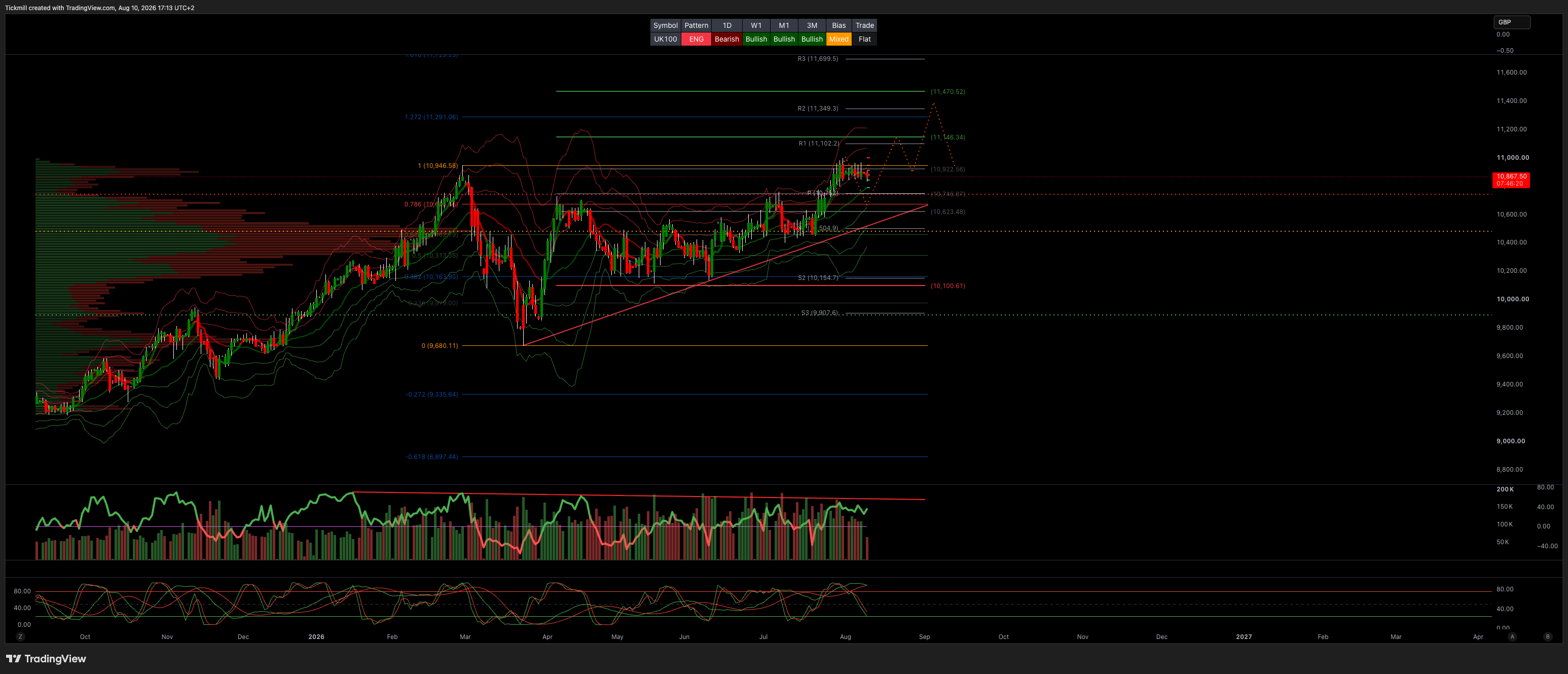
TECHNICAL & TRADE VIEW – FTSE100
Daily VWAP Bearish
Weekly VWAP Bullish
Above 10700 Target 11150
Below 10400 Target 9500
Disclaimer: The material provided is for information purposes only and should not be considered as investment advice. The views, information, or opinions expressed in the text belong solely to the author, and not to the author’s employer, organization, committee or other group or individual or company.
Past performance is not indicative of future results.
High Risk Warning: CFDs are complex instruments and come with a high risk of losing money rapidly due to leverage. 68% and 74% of retail investor accounts lose money when trading CFDs with Tickmill UK Ltd and Tickmill Europe Ltd respectively. You should consider whether you understand how CFDs work and whether you can afford to take the high risk of losing your money.
Futures and Options: Trading futures and options on margin carries a high degree of risk and may result in losses exceeding your initial investment. These products are not suitable for all investors. Ensure you fully understand the risks and take appropriate care to manage your risk.
Patrick has been involved in the financial markets for well over a decade as a self-educated professional trader and money manager. Flitting between the roles of market commentator, analyst and mentor, Patrick has improved the technical skills and psychological stance of literally hundreds of traders – coaching them to become savvy market operators!