Institutional FX Insights: Deutsche Bank ' Where are the AI FX tails widest'

The Micro Macro Setup
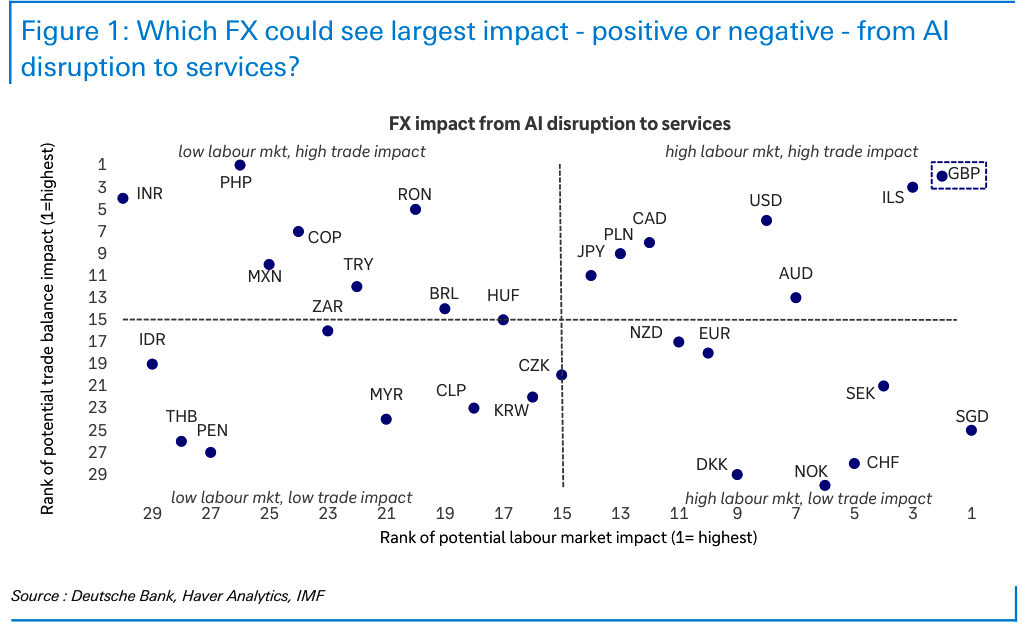
Widespread AI integration is driving the marginal cost of cognitive labor toward zero. To trade this, we evaluated 30 major currencies across two vectors: labor market vulnerability to AI automation and net trade reliance on service exports.
Our framework does not call a directional winner. Instead, it measures fat-tail volatility potential—where macro outcomes will be the most extreme.
Key Findings: Ground Zero is the British Pound
Metric | UK Profile | Macro Risk |
Labor Force Exposure | High share of knowledge-based, white-collar workforce | High structural job reallocation risk |
Trade Dynamics | Massive net exporter of services; net importer of physical goods | Current Account vulnerability to export repricing |
Policy Impact | High focus (e.g., launch of the UK AI Economics Institute) | Heavy reliance on fiscal/monetary policy intervention |
The Bull Tail (Hyper-Productivity): UK service sectors capture massive margin expansion, driving a surge in productivity and structural capital inflows. GBP outperforms massively.
The Bear Tail (Termsof-Trade Deficit): AI commoditizes high-value service exports while physical goods import costs remain sticky. UK trade balance collapses alongside severe labor market friction. GBP suffers structural devaluation.
Retail Trader Takeaways & Trade Setup
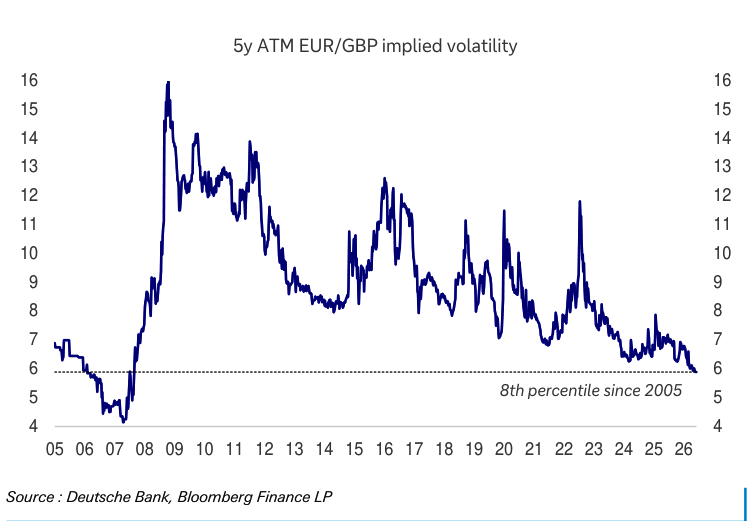
Because long-dated volatility does not reflect this macro divergence, directional bets carry unnecessary tail risk. Instead, structure for tail uncertainty.
[Low Volatility Environment] ──> Buy Volatility (Strangle Strategy) ──> Profit from Large Breakout (Up or Down)
The Trade: Long EUR/GBP Strangle
The Opportunity: Longer-dated implied volatility in EUR/GBP sits near historical lows, mispricing the multi-year macro divergence between a service-heavy UK and a goods/manufacturing-centric Eurozone.
Structure: Buy Out-of-the-Money (OTM) EUR/GBP Calls + Buy OTM EUR/GBP Puts (same long-dated expiration, e.g., 6M to 1Y+).
Execution:
Target low-implied-volatility entry windows.
Avoid short-dated options; structural AI reallocation requires time to show up in macro data.
Exit or rebalance on major volatility spikes (delta expansion) regardless of direction.
Disclaimer: The material provided is for information purposes only and should not be considered as investment advice. The views, information, or opinions expressed in the text belong solely to the author, and not to the author’s employer, organization, committee or other group or individual or company.
Past performance is not indicative of future results.
High Risk Warning: CFDs are complex instruments and come with a high risk of losing money rapidly due to leverage. 68% and 74% of retail investor accounts lose money when trading CFDs with Tickmill UK Ltd and Tickmill Europe Ltd respectively. You should consider whether you understand how CFDs work and whether you can afford to take the high risk of losing your money.
Futures and Options: Trading futures and options on margin carries a high degree of risk and may result in losses exceeding your initial investment. These products are not suitable for all investors. Ensure you fully understand the risks and take appropriate care to manage your risk.
Patrick has been involved in the financial markets for well over a decade as a self-educated professional trader and money manager. Flitting between the roles of market commentator, analyst and mentor, Patrick has improved the technical skills and psychological stance of literally hundreds of traders – coaching them to become savvy market operators!