FTSE Caps Best Week Since April
FTSE Caps Best Week Since April
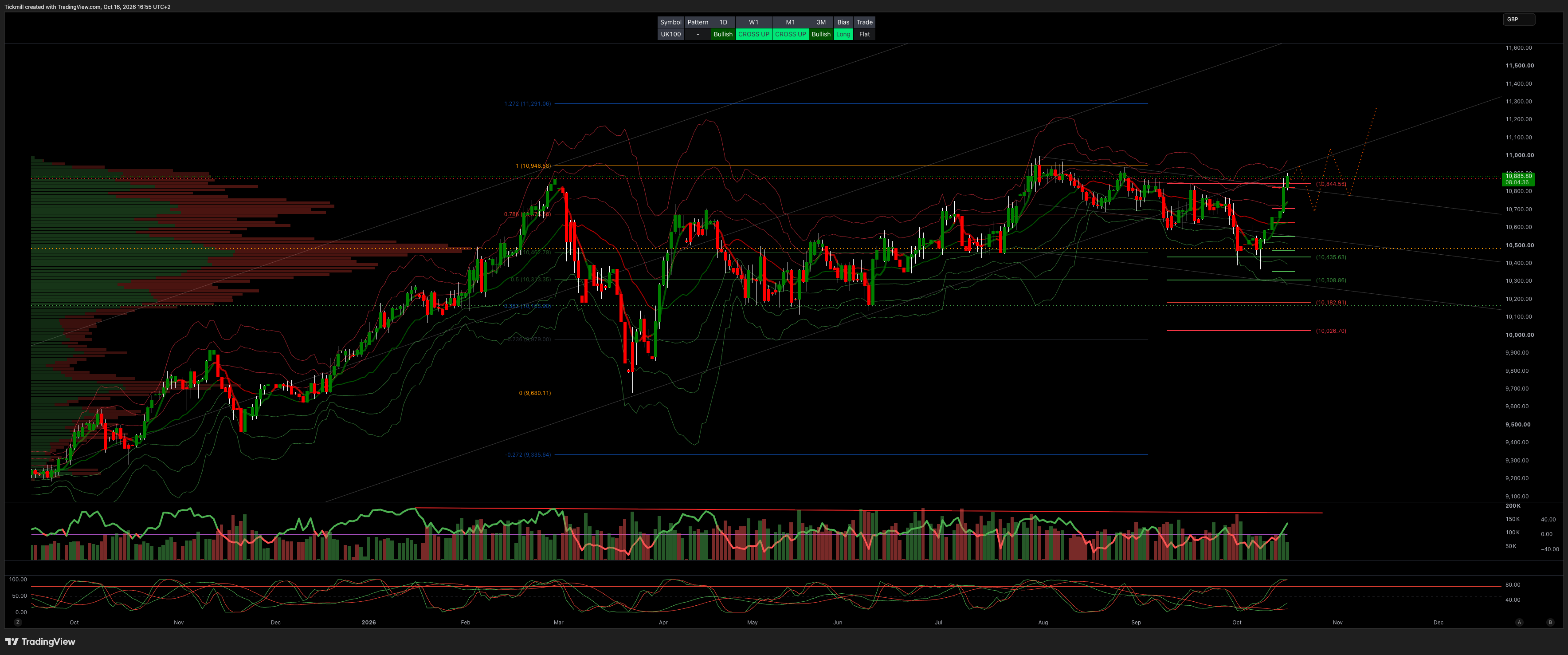
London's benchmark FTSE 100 edged slightly lower on Friday to trade around 10,831.70 points near midday before steadying into the afternoon, but remained firmly on track to cap its best weekly performance since early April. Investors sought shelter in U.K. defensive and personal goods sectors amid a global rout in AI-linked equities, while a pullback in government bond yields provided underlying support ahead of next week's crucial domestic inflation and labor market data releases.
Sector performance diverged sharply across the top flight. Defense contractors provided vital baseline support to limit broader market losses, led by gains across BAE Systems, Melrose Industries, and Babcock International, which advanced between 1.5% and 3.7%. The personal goods sector posted an impressive 7.2% weekly surge, while the defensive healthcare sector locked in a weekly gain of nearly 5% despite a modest 1% Friday pullback that saw heavyweights AstraZeneca and GSK slip 1.8% and 1.0%, respectively. Outside the main index, e-commerce group THG jumped 6.7%—extending a 16% surge from Thursday after raising its full-year adjusted core profit forecast—while the mid-cap FTSE 250 climbed 0.55%.
Conversely, domestic banking heavyweights faced notable selling pressure following reports in The Guardian indicating Finance Minister John Healey is preparing targeted tax measures for U.K. lenders in the upcoming October 28 Budget. Market analysts noted that while large international institutions may see limited impact, domestic retail lenders remain particularly exposed, driving NatWest Group and Lloyds Banking Group down 2.2% each.
On the macroeconomic and central bank fronts, U.K. 10-year benchmark Gilt yields headed for weekly declines, snapping three consecutive weeks of increases. Speaking ahead of next week's data releases, Bank of England Governor Andrew Bailey noted that signs of second-round inflation effects remain limited, though money markets continue to price in roughly four 25-basis-point BoE rate hikes over the next 12 months according to LSEG terminal pricing.
Looking ahead, next week presents a heavily U.K.-centric economic calendar. Tuesday kicks off with key labor market and wage figures, where recent survey indicators point to a mild contraction in hiring across PAYE metrics. Wednesday brings crucial September CPI and public borrowing numbers, essential for assessing underlying price risks as headline inflation faces upward pressure from regulated home energy price cap resets. Friday rounds out the week with retail sales data and preliminary October Flash PMIs across the U.K., Eurozone, and U.S.
Finish Line: U.K. equities capped a stellar weekly performance on a resilient footing, as strong demand for defensive healthcare, defense, and personal goods counters insulated the FTSE 100 from a global technology sell-off. While budget tax speculation weighed on domestic banks, declining gilt yields and steadying inflation expectations keep the market anchored near multi-week highs entering a key macro data week.
Disclaimer: The material provided is for information purposes only and should not be considered as investment advice. The views, information, or opinions expressed in the text belong solely to the author, and not to the author’s employer, organization, committee or other group or individual or company.
Past performance is not indicative of future results.
High Risk Warning: CFDs are complex instruments and come with a high risk of losing money rapidly due to leverage. 68% and 74% of retail investor accounts lose money when trading CFDs with Tickmill UK Ltd and Tickmill Europe Ltd respectively. You should consider whether you understand how CFDs work and whether you can afford to take the high risk of losing your money.
Futures and Options: Trading futures and options on margin carries a high degree of risk and may result in losses exceeding your initial investment. These products are not suitable for all investors. Ensure you fully understand the risks and take appropriate care to manage your risk.
Patrick has been involved in the financial markets for well over a decade as a self-educated professional trader and money manager. Flitting between the roles of market commentator, analyst and mentor, Patrick has improved the technical skills and psychological stance of literally hundreds of traders – coaching them to become savvy market operators!